
Polishing Motor Selection
DIY and Woodworking: 3.0kW.
Hardware Processing: Minimum 3.0kW, depending on work volume and frequency of use.
Jewelry Polishing: Use a small, adjustable-speed polishing machine (220V, 1.5kW, 2850 RPM) (it is very powerful and widely applicable; Jingzheng brand is recommended).
Small Processing Plants: Minimum 3.0kW, depending on work volume and frequency of use.

Common Polishing Motor Malfunctions Analysis
Polishing motor does not turn on power/makes a humming sound and requires external force to start (Fault No. 1) - Core causes: Damaged starting capacitor (most common in single-phase motors), loose wiring, partial short circuit in windings.
Polishing motor overheats/becomes hot to the touch - What causes this? (Fault No. 2) - Core causes: Overload operation, clogged heat dissipation holes, damaged bearings, unstable voltage.
Polishing motor makes a lot of noise/vibrates violently - How to repair this? (Fault No. 3) - Core causes: Worn bearings, rotor imbalance, loose base, eccentric polishing wheel.
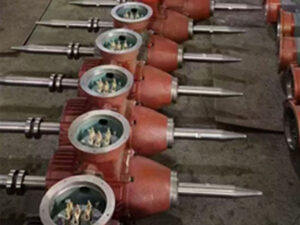
What are the voltage differences between polishing motors?
What are the differences between single-phase and three-phase polishing motors? How to choose between household and industrial applications?
- Key differences:
Single-phase 220V (Household/Small)
Three-phase 380V (Industrial/High-power, Higher Torque and More Stable)
How to Choose the Polishing Motor Speed?
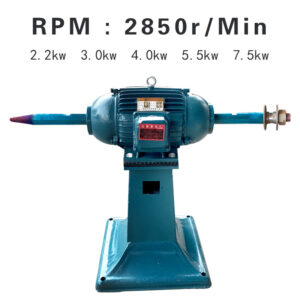
The commonly used speed for polishing motors is 2850 RPM, but 1440 RPM is also available. There are also dual-speed motors (one machine with two speeds: a fast 2850 RPM and a slow 1440 RPM) and variable-speed motors (the speed can be adjusted arbitrarily via a frequency converter; note that even with a frequency converter, a 1440 RPM motor's maximum speed is still 1440 RPM; similarly, a 2850 RPM motor's maximum speed with a frequency converter is 2850 RPM).
- Key Difference:
While the 1440 RPM motor is slower, it is more powerful, and most people choose 2850 RPM.
The 2850 RPM motor is faster and suitable for polishing hardware, automotive, and metal industries, making it the choice for the vast majority of users.
Can a polishing motor be modified into a belt sander/grinder?
Yes, a polishing motor can be modified into a belt sander/grinder. Modification considerations:
Power matching
Shaft diameter compatibility
Reinforced base
Enhanced protection
It is crucial to choose a reliable polishing motor manufacturer. All modification parts must be custom-made to fit the chosen motor. If the selected motor is of poor quality, all your efforts will be wasted.
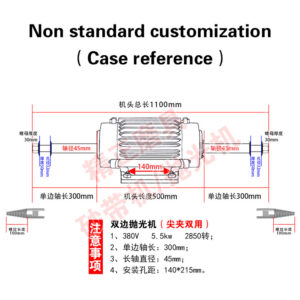
Conclusion: Before choosing a polishing motor, it is essential to find a reliable manufacturer. A capable and professional manufacturer can recommend suitable models based on your needs, or even customize a non-standard polishing motor to facilitate future use or modification.