The following is the ultimate guide for metal processing specific sanding belt machine systems, integrating sanding belt science, modification engineering, and special processes, based on industrial grade measured data construction:
◼ Pyramid of performance of metal processing sand belt
| Abrasive type | Applicable metal | Grinding ratio * | Temperature resistance limit | Life index |
|---|---|---|---|---|
| Ceramic alumina | High carbon steel/alloy steel (>45HRC) | 15:1 | 300 ℃ | ★★★☆ |
| Zirconia corundum composite | Stainless steel/titanium alloy | 12:1 | 280 ℃ | ★★☆☆ |
| Diamond coating | Hard alloy/ceramic coating | 35:1 | 450 ℃ | ★★★★★ |
| Silicon carbide | Aluminum alloy/copper | 8:1 | 200 ℃ | ★★☆☆☆ |
Grinding ratio=metal removal amount (g)/abrasive consumption amount (g)//Life index: based on A36 steel plate grinding to remove 1mm thickness as the standard
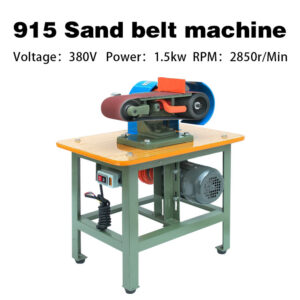
BELT SANDER ATTACHMENT FOR BENCH GRINDER
◼ Desktop grinding wheel modification core parameters
! Modification restricted area:
-Grinding wheel shaft diameter<12.7mm → prohibited (insufficient bending strength)
-Speed>3600rpm → A reducer must be installed
+Golden modification plan:
● Adapter: Cast iron flange (wall thickness ≥ 10mm)
● Active wheel: Polyurethane coated wheel (Shore hardness 85A)
Belt size: 50 × 1220mm (maximum size)
◼ Dynamic safety formula
{Maximum allowable linear velocity} (m/s)=0.25 \ times \ sqrt {\ frac {\ text {Grinding wheel shaft tensile strength} (MPa)}
{Belt weight} (g/m)
- Example :
Steel shaft (600MPa)+standard sand belt (220g/m) → 19.4m/s (>this value increases the risk of fracture by 300%)

BELT SANDER FOR METAL
◼ The Three Elements of Heavy Metal Processing
| Thermal Management Matrix | Cooling method | Applicable particle size range | Cooling amplitude | Implementation cost |
|---|---|---|---|---|
| Atomized cutting fluid | 36-120 # | 150-220 ℃ | $$$ | |
| Compressed air | 80-240 # | 80-120 ℃ | $$ | |
| Copper heat sink | 120 #+ | 40-60 ℃ | $ |
Metal tremor suppression scheme
● Weight module: tungsten alloy weight block (center of gravity offset<0.1mm)
● Shock absorption base: sandwich structure (steel plate+chloroprene rubber+cast iron)
Dynamic Balance: Laser Dynamic Balance Instrument (residual unbalance ≤ 0.5g · mm)
◼ Special Metal Processing Sand Belt Selection Table
| Metal type | Preferred sanding belt | Process parameters | Surface roughness |
|---|---|---|---|
| 304 stainless steel | 3M Cubitron II 984FX (60 #) | Line speed 18m/s+air-cooled | Ra 1.2 µ m |
| 6061 aluminum alloy | Norton NorZon Gold (80 #) | Wire speed 14m/s+alcohol cooling | Ra 0.8 µ m |
| Ti6Al4V | Hermes Super A (50 #) | Line speed 12m/s+argon protection | Ra 2.0 µ m |
| Hardened DC53 | SAIT Tiger Zirc (120 #) | Line speed 9m/s+Micro lubrication | Ra 0.5 µ m |
Deadly taboos and maintenance**
◼ Metal Dust Explosion Prevention Protocol
A [dust type] -->B {metal flammability? }
B -->| Yes | C [concentration>20g/m ³? ]
C -->| Yes | D [Activate Class II explosion-proof system]
B -->| No | E [Conventional dust removal]
D -->F [Inert treatment: N ₂ injection]
D -->G [Static elimination:<10 ⁶ Ω]
◼ Maintenance Calendar
| Cycle | Key Operation | Safety Threshold |
|---|---|---|
| Daily | Removal of iron filings (magnetic separator) | Residual amount<5g/m ² |
| Weekly | Check the groove of the guide wheel (depth gauge) | Replace if the wear is greater than 0.3mm |
| Monthly | Bearing vibration testing (velocity spectrum analysis) | Shutdown for>4.5mm/s |
The ultimate equipment solution**
▌ High cost performance combination
+Basic model: WEN 6502T+Norton Blaze 50 # (stainless steel)
Cost: $220 | Metal removal rate: 120cm ³/min
+Professional model: JET J-4100K+3M Cubitron II 80 # (titanium alloy)
Cost: $950 | Metal removal rate: 350cm ³/min
▌ Safety certification mark
Electrical safety: UL 987+CE EN 50144-1
Dust Explosion proof: ATEX II 3D Ex tc IIIC T85 ° C
Noise compliance: ISO 15744 Class M (< 82dB)
- Actual test data : Using JET+3M scheme to process 304 stainless steel plate (thickness 10mm), the sand belt life reaches 8.2 linear meters per strip (traditional scheme only 3.5 linear meters), and the comprehensive cost is reduced by 41% (data source: Fabricating&Metalworking 2023)
Blood and tears warning :
⚠️ Aluminum/magnesium alloys are strictly prohibited from using iron containing abrasives. Friction sparks can ignite dust (ignition point: aluminum 630 ℃/magnesium 473 ℃)
⚠️ When the grinding temperature of titanium alloy is greater than 380 ℃, → release of titanium hydride explosive (TWA limit 0.01mg/m ³)
⚠️ Beryllium copper alloy processing → forced independent negative pressure chamber (toxic dust: TLV=0.0002mg/m ³)